
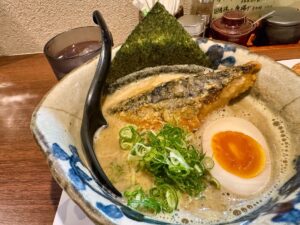
Nabura… apparently a fisherman’s term meaning “school of fish,” this word was chosen as the name for a ramen shop that opened in Kyoto’s Senbon Imadegawa area in July 2022. True to its fish-related name, the shop’s signature dish is apparently “Japanese-style ramen topped with fried mackerel.” Hearing that made me nostalgic for mackerel ramen, reminding me, “Come to think of it, there used to be a ramen shop called Saba 6 Seimenjo…” So one evening, I hopped on the city bus and headed to Senbon Imadegawa to visit the shop. Now then, what was this mackerel ramen at Nabura Head Shop like…?
The owner, who worked as a Japanese cuisine chef for 35 years, started his own ramen shop… Nabura Head Shop is a ramen shop like this…
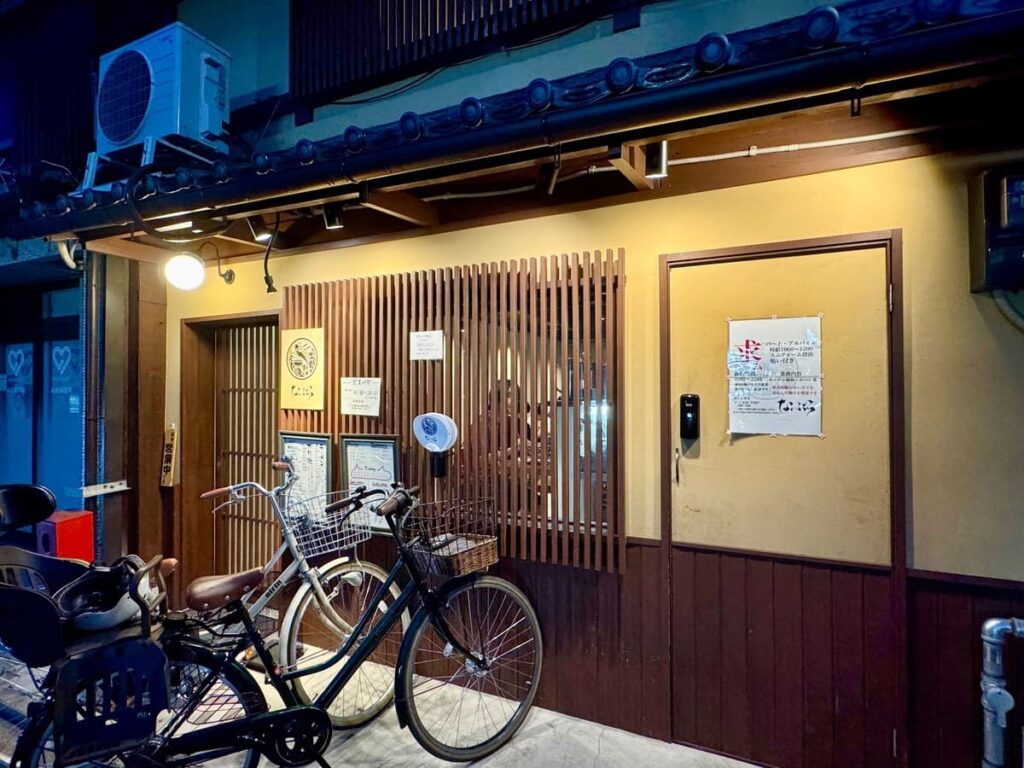
But first, let me briefly introduce this place called Nabura Head Shop. The shop is located on the south side of Kyoto’s historic hanamachi district, Kamishichiken, on the left side of Shichihonmatsu Street heading south from the Kamishichiken intersection. Though it’s a relatively new ramen shop, only in its third year of operation, the owner apparently worked as a Japanese cuisine chef for 35 years before starting this ramen venture. Just hearing about his career makes us confident this shop’s ramen simply can’t be bad.
Stepping inside the shop, which resembles a traditional Kyoto townhouse (Kyoto machiya), you’ll find a relatively spacious interior for a ramen shop, featuring seven counter seats and a table seating eight. At the back of the shop is a small courtyard garden, offering a visual delight while slurping the ramen. The shop’s layout is also barrier-free, easily accessible for wheelchairs. When I visited, there were families with small children, giving off a sense of warmth and inclusivity that welcomes all types of customers.
It’s super rich but somehow gentle on the stomach… How was Nabura Head Shop’s ramen?
Alright, let me introduce the signature ramen I ordered at Nabura Head Shop that day. This ramen comes in four sizes: Regular (1 serving), Medium (1.5 servings), Large (2 servings), and Extra Large (3 servings). After consulting my stomach, I went with the Regular (price: 940 yen including tax).

After about a 10-minute wait, the ramen arrived looking like this. The bowl is on the smaller side, and visually, the portion looks about 3/4 the size of a typical ramen bowl. Perched atop the soup, which looks incredibly rich just by looking at it, sits the famous mackerel Tatsuta-age as the main topping. Oh, right—instead of getting a larger bowl of ramen this time, I added chicken karaage as a side. This “Chicken Karaage Set” with two pieces costs an extra ¥360…
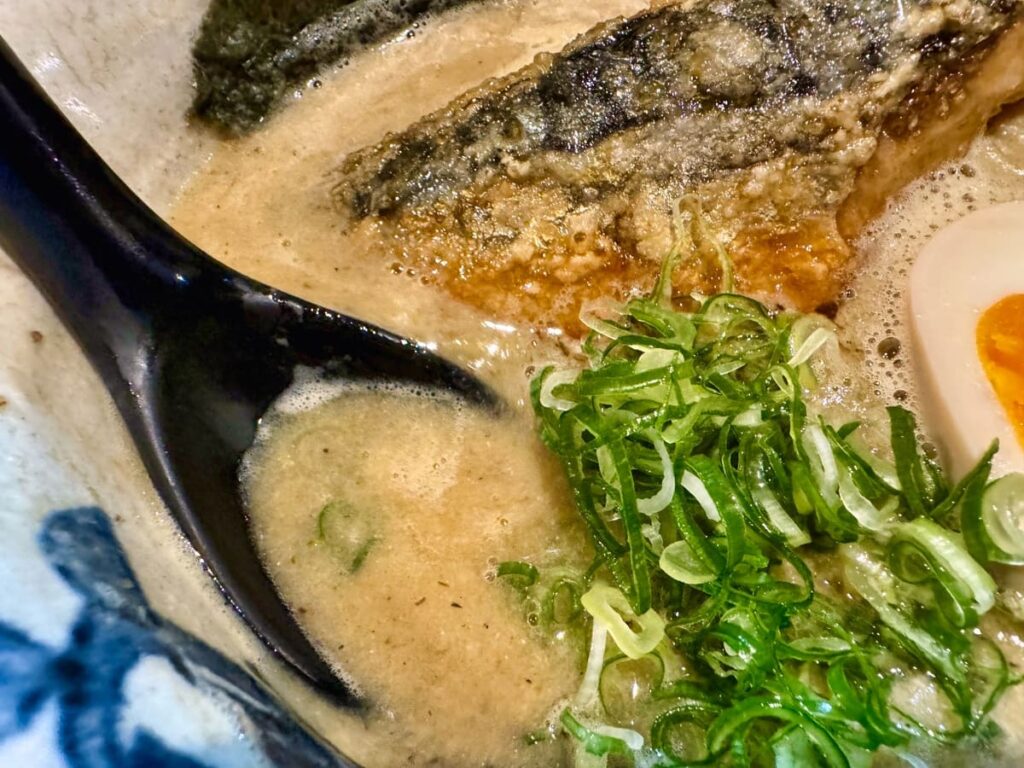
Now, taking a sip of the soup… Just as it looks, the mackerel’s umami is packed in, making it incredibly rich. The mackerel flesh probably melts into the broth too… occasionally, bits that feel like it create a slightly gritty sensation on the tongue. On the other hand, the saltiness and fat content are restrained, making it a very gentle flavor. This soup uses only mackerel and kombu for its broth, is completely free of artificial seasonings, and doesn’t use fish powder either, so it doesn’t make you thirsty at all while drinking it. You could say it’s a soup that achieves both rich umami and healthiness.

The noodles paired with this are thick, flat-style noodles with a slight curl and whole wheat flour. The curls on the noodles effectively soak up the rich broth, so with every slurp, the mouth fills with the intense umami of mackerel. The noodles are cooked firm, offering a strong bite and excellent texture. Yet, surprisingly, they don’t feel heavy; they slide down smoothly into the stomach and don’t cause any discomfort after eating.
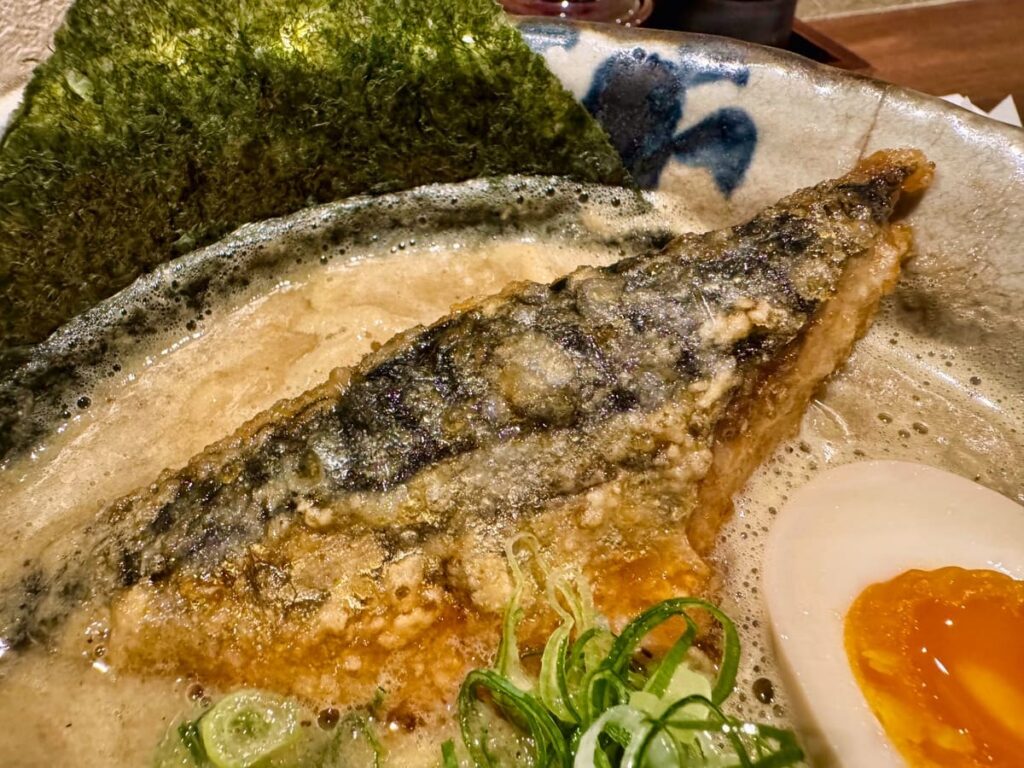
The main topping is the mackerel Tatsuta-age. Though called Tatsuta-age, the batter is extremely thin, so honestly, it doesn’t feel much like fried food. It’s also barely seasoned, making it a Tatsuta-age that feels like it’s saying, “We’re betting on the pure taste of mackerel!” It’s delicious enough on its own, but when fully soaked in the rich mackerel broth and taken into the mouth… well, I’ll leave the rest to your imagination.
On the table, four condiments are provided for flavor variation: garlic, pepper, sansho pepper, and spicy miso. As the shop recommends, pairing it with sansho pepper was the best. Adding sansho boosts the Japanese flavor profile even more. You feel that refreshing tingle from the sansho while it slides down smoothly and easily. Nabura Head Shop‘s ramen is a winner. If such a body-friendly ramen is available at this price, I’d be tempted to visit daily if it were near my home.
Nabura Head Shop’s Other Menu Items (Prices Include Tax)
- White Rice 200 yen (One free refill)
- Tsukemen (Regular) 980 yen
- Extra Mackerel Tatsuta 180 yen
- Extra Simmered Egg 100 yen
- Extra Chopped Kujo Green Onions 60 yen
- Mackerel Flakes Rice 380 yen
- Homemade Dashi Soy Sauce Tamago Kake Gohan 350 yen
Nabura also has a branch in Mototanaka…Access to Nabura Head Shop: From JR San’in Main Line Nijo Station, take City Bus Route 206 bound for Kitaoji Bus Terminal. Get off at Senbon Nakadachiuri bus stop and walk 7 minutes.
Besides the main store at Senbon Imadegawa introduced here, Nabura also operates a second location, Nabura Mototanaka Branch, along Higashioji Street in Mototanaka. This new branch opened on May 30, 2024, and serves the same completely chemical-free mackerel broth ramen as the main store. It’s wonderful that you can enjoy this ramen in both the western and eastern parts of Kyoto, despite the distance. Try this completely chemical-free mackerel broth ramen at whichever location is more convenient for you! Now, here are the shop details…
Nabura Head Shop Out of 5
Total Seats: 15 (including 7 counter seats)
Address: 323-2 Sasayacho 5-chome, Kamigyo-ku, Kyoto-shi, Kyoto 602-8453
Phone: 075-432-7587
Hours: 11:30 AM – 10:00 PM
Closed: Mondays (If Monday is a holiday, closed Tuesday instead)
Parking: None
Credit Cards: Not accepted (Ticket system)
P.S. If you are looking for delicious ramens in Kyoto, please stop by this article below…
Leave a Reply